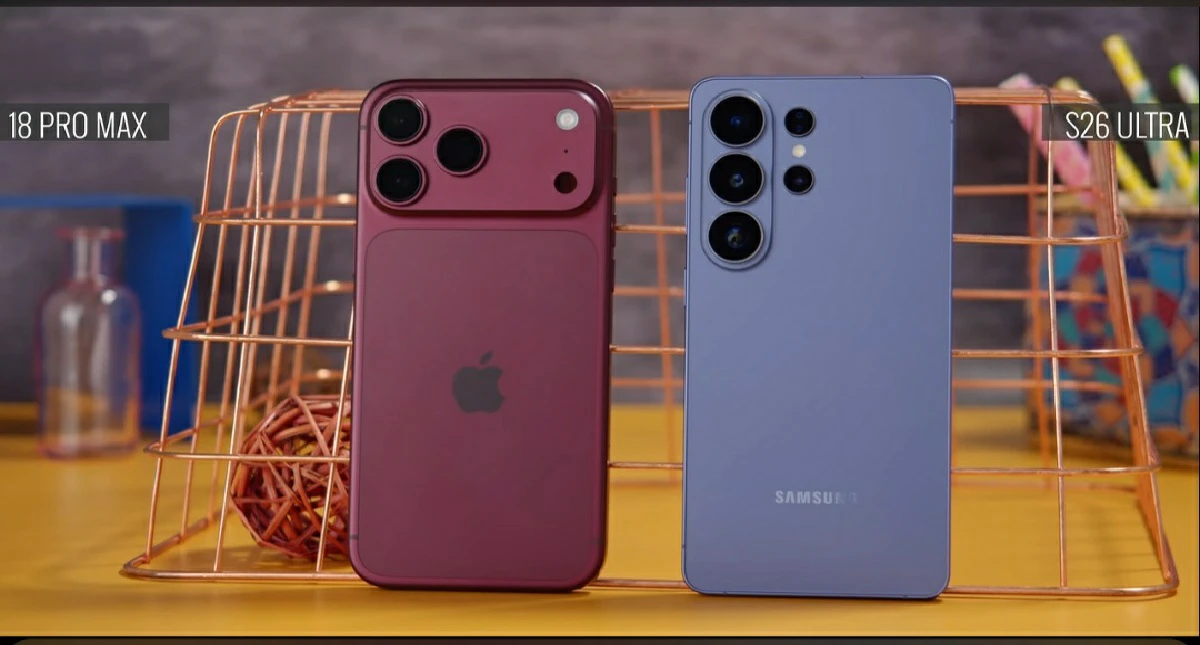
The Apple iPhone 18 Pro Max and Samsung Galaxy S26 Ultra represent the best of what Apple and Samsung have to offer in their respective flagship smartphone lineups. Both devices combine premium construction, large 6.9-inch displays, powerful processors, advanced camera systems and sophisticated AI features. However, they approach the flagship experience differently, with Apple focusing on performance, battery endurance, video recording and its iOS ecosystem, while Samsung offers greater display resolution, versatile zoom photography, an integrated S Pen and additional productivity features.
The iPhone 18 Pro Max introduces Apple’s A20 Pro chipset, an improved cooling system, a variable-aperture main camera and a larger battery. The Galaxy S26 Ultra counters with the Snapdragon 8 Elite Gen 5 for Galaxy, a 200MP primary camera, two dedicated telephoto cameras and its distinctive Privacy Display technology.
Both smartphones are expensive premium devices, but there are meaningful differences in their hardware and everyday capabilities. If you are deciding between these two flagship phones, understanding where each one excels will help you determine which deserves your attention.
Apple iPhone 18 Pro Max vs Samsung Galaxy S26 Ultra: At a Glance
| Features | Apple iPhone 18 Pro Max | Samsung Galaxy S26 Ultra |
|---|---|---|
| Display | 6.9-inch LTPO Super Retina XDR OLED | 6.9-inch Dynamic LTPO AMOLED 2X |
| Resolution | 1320 x 2868 pixels | 1440 x 3120 pixels |
| Refresh Rate | 120Hz | 120Hz |
| Processor | Apple A20 Pro (2nm) | Snapdragon 8 Elite Gen 5 (3nm) |
| RAM | 12GB | 12GB / 16GB |
| Storage | 256GB, 512GB, 1TB, 2TB | 256GB, 512GB, 1TB |
| Main Camera | 48MP | 200MP |
| Telephoto Camera | 48MP, 4x optical zoom | 10MP 3x + 50MP 5x optical zoom |
| Ultrawide Camera | 48MP | 50MP |
| Front Camera | 18MP | 12MP |
| Video Recording | Up to 4K at 120fps | Up to 8K at 30fps |
| Operating System | iOS 27 | Android 16, One UI 9 |
| Battery | 5391mAh / 5567mAh | 5000mAh |
| Wired Charging | 54W | 60W |
| Wireless Charging | 25W | 25W |
| Water Resistance | IP68, up to 6m | IP68, up to 1.5m |
| Fingerprint Scanner | No | Ultrasonic under-display |
| Face Recognition | Face ID | Face Unlock |
| Stylus | No | Integrated S Pen |
| Weight | 249g | 214g |
| Thickness | 8.8mm | 7.9mm |
| Starting Storage | 256GB | 256GB |
| Memory Card Slot | No | No |
| Starting Price | Over $1,500 | Over $850 |
Design and Build Quality
The iPhone 18 Pro Max and Samsung Galaxy S26 Ultra are both large premium smartphones designed to deliver a high-end experience. Their similar screen sizes mean neither device is particularly compact, but there is a noticeable difference when it comes to their weight and thickness.
The iPhone 18 Pro Max measures 163.4 x 78 x 8.8mm and weighs 249g. The Galaxy S26 Ultra measures 163.6 x 78.1 x 7.9mm and weighs 214g. Although their overall dimensions are remarkably close, Samsung has managed to make its flagship considerably lighter and thinner.
The difference is approximately 35g, which is noticeable when holding either phone for extended periods. If you prefer a large smartphone that feels lighter in your hand, the Galaxy S26 Ultra has the advantage. The iPhone, on the other hand, feels considerably heavier, although its larger weight does not necessarily indicate a difference in overall build quality.
Both smartphones use premium materials, with reinforced glass on the front and back and aluminum frames. The iPhone 18 Pro Max features Ceramic Shield 2 protection on the front, while Samsung uses Corning Gorilla Armor 2 on the front and Gorilla Glass Victus 2 on the rear.
Both devices also carry an IP68 rating for dust and water resistance. However, Apple’s specifications provide protection against immersion in water up to 6 metres for 30 minutes, whereas Samsung specifies up to 1.5 metres for the same duration. This gives the iPhone a higher rated water-immersion depth, although neither phone should be treated as completely waterproof.
Another difference is the physical controls. The iPhone 18 Pro Max comes with Apple’s Action button, which can be configured to perform shortcuts and other functions, alongside the Camera Control button for accessing and operating the camera.
These additional controls provide convenient ways to access certain functions without navigating through the touchscreen. The Galaxy S26 Ultra does not offer the same combination of dedicated buttons, but it has a different advantage in the form of its integrated S Pen.
Overall, both phones deliver the premium construction expected at this level, but the Galaxy is noticeably lighter and thinner, while the iPhone offers additional camera controls and a greater specified water-immersion depth.
Display Quality and Features
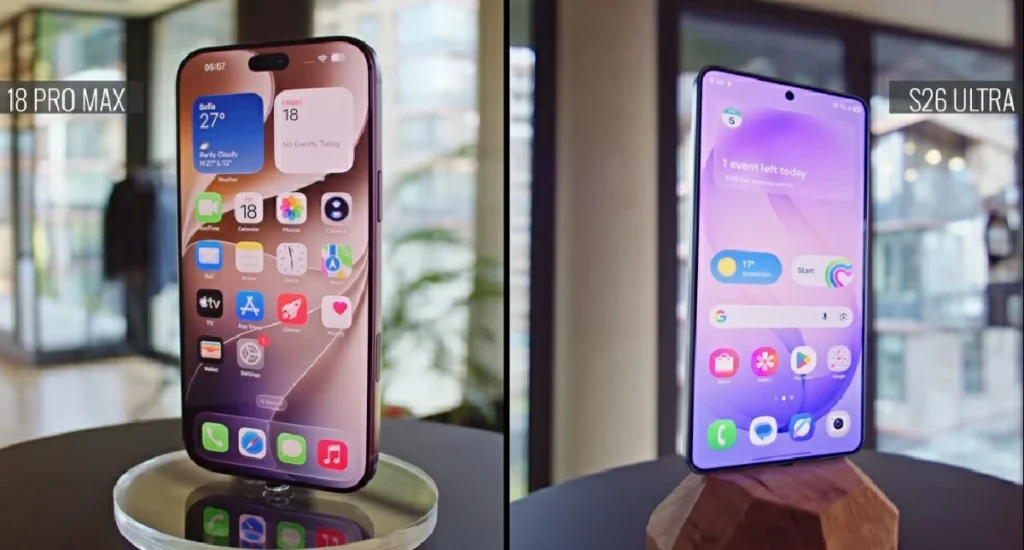
Both smartphones feature a large 6.9-inch display, making them equally suitable for watching videos, browsing, gaming and handling multiple applications. However, their display technologies and resolutions are slightly different.
The iPhone 18 Pro Max uses an LTPO Super Retina XDR OLED panel with a resolution of 1320 x 2868 pixels. This produces approximately 460 pixels per inch, providing excellent sharpness for text, photographs and videos.
The Samsung Galaxy S26 Ultra uses a Dynamic LTPO AMOLED 2X display with a higher resolution of 1440 x 3120 pixels. Its pixel density reaches approximately 500ppi, giving it a numerical advantage over the iPhone.
Both displays support adaptive refresh rates of up to 120Hz. This allows scrolling, animations and supported games to appear smoother than they would on a conventional 60Hz screen. The LTPO technology also allows the refresh rate to adjust depending on what is happening on the display, helping to manage power consumption.
Although Samsung has the sharper display on paper, the difference is difficult to notice during normal viewing. Both screens are sufficiently detailed, and you can expect excellent clarity when reading text, viewing photographs or streaming high-resolution content.
The iPhone supports HDR10 and Dolby Vision, while Samsung offers HDR10+ support. These technologies improve the viewing experience by delivering more detailed highlights, deeper contrast and a wider range of colours in compatible content.
Brightness is another important consideration. The iPhone 18 Pro Max offers 1,000 nits of typical brightness, 1,600 nits in high-brightness mode and up to 3,000 nits of peak brightness. Samsung specifies a peak brightness of 2,600 nits.
Despite the different specifications, measured peak brightness is comparable between the two smartphones. Both also feature anti-reflective coatings that help reduce reflections from surrounding light. This makes outdoor viewing more comfortable, particularly when using either phone under direct sunlight.
The Galaxy S26 Ultra also introduces one of its most distinctive display features: Privacy Display.
Samsung Galaxy S26 Ultra Privacy Display
The Privacy Display is a particularly interesting addition to Samsung’s flagship. It is designed to limit how much of your screen can be seen by people looking at your phone from an angle.
This works similarly to a privacy screen protector, making it more difficult for someone beside you to read messages, view private information or see what you are doing on your device.
You can activate or deactivate the feature whenever necessary. It can also be configured to work with specific content, such as passwords, rather than applying the privacy effect to everything displayed on the screen.
This is useful when accessing sensitive information in public places or working with private content around other people.
The iPhone does not offer an equivalent built-in privacy display feature.
Dynamic Island vs Punch-Hole Display
Another visible difference is the front camera cutout.
The iPhone 18 Pro Max retains Apple’s Dynamic Island design, although the cutout has been reduced compared with earlier generations. It continues to accommodate the front-facing camera and Face ID hardware.
The Dynamic Island also serves as an interactive area for displaying information such as timers, music playback and shortcuts without requiring you to open the corresponding applications.
Samsung takes a simpler approach with a smaller punch-hole cutout for its front-facing camera. This gives the Galaxy S26 Ultra a less intrusive camera opening, leaving more of the display visually uninterrupted.
Both designs have their advantages. Apple’s Dynamic Island offers additional functionality, while Samsung’s smaller camera cutout provides a cleaner appearance.
Overall, both smartphones have excellent displays. Samsung wins in resolution and offers the additional Privacy Display feature, while Apple provides Dolby Vision support and a useful Dynamic Island interface.
Biometric Security and Authentication
Apple and Samsung approach biometric authentication differently, and this is another area where the two smartphones have distinct advantages.
The iPhone 18 Pro Max relies on Face ID as its biometric authentication system. It uses the front-facing camera assembly together with dedicated 3D depth-sensing hardware to recognise your face.
This makes it more sophisticated than conventional camera-based face unlocking because the system uses additional depth information to verify that it is seeing a real face rather than simply an image.
You can use Face ID to unlock your phone, authorise supported purchases and authenticate access to compatible applications.
The Galaxy S26 Ultra, on the other hand, features an ultrasonic fingerprint scanner built directly into the display. This allows you to unlock the phone by placing your registered finger on the designated area of the screen.
It also supports face recognition, although its conventional face-unlock implementation does not offer the same level of dedicated 3D facial authentication as Apple’s Face ID.
Samsung’s fingerprint scanner gives you another convenient authentication option, particularly if you prefer unlocking your phone without pointing it towards your face.
Neither approach is necessarily inconvenient, but they offer different experiences. If advanced facial recognition is important to you, the iPhone has the advantage. If you prefer an under-display fingerprint scanner, the Galaxy S26 Ultra is the better choice.
S Pen and Additional Hardware Features
One of Samsung’s biggest advantages over the iPhone 18 Pro Max is its integrated S Pen.
The Galaxy S26 Ultra includes a stylus that can be used for writing, drawing, navigating the interface and interacting with compatible applications. This makes the phone particularly useful if you regularly take handwritten notes, annotate documents or prefer more precise input than your fingers can provide.
The iPhone 18 Pro Max does not have an integrated stylus or an equivalent built-in writing accessory.
Samsung also supports additional productivity features through its software and Samsung DeX. DeX allows you to use the smartphone in a desktop-style environment when connected to a compatible external display, providing another way to handle productivity tasks.
These capabilities make the Galaxy S26 Ultra more versatile if you want your smartphone to double as a productivity device.
Performance and Processing Power
Performance is one of the most important differences between these two flagship smartphones. Apple equips the iPhone 18 Pro Max with its latest A20 Pro chipset, while Samsung uses Qualcomm’s Snapdragon 8 Elite Gen 5 for Galaxy.
The A20 Pro is manufactured using a 2nm process and features a hexa-core CPU consisting of two performance cores clocked at up to 4.93GHz and four additional cores running at up to 2.64GHz. Graphics are handled by Apple’s seven-core GPU.
Samsung’s Snapdragon 8 Elite Gen 5 is manufactured using a 3nm process. Its octa-core CPU consists of two high-performance cores running at up to 4.74GHz and six additional cores reaching up to 3.62GHz. Graphics processing is handled by the Adreno 840 GPU.
Both processors are designed for demanding flagship workloads, including intensive applications, advanced photography, high-resolution video processing and mobile gaming.
Benchmark comparisons give the iPhone 18 Pro Max an advantage in both CPU and GPU performance. Samsung’s enhanced Snapdragon chipset still delivers impressive results, but Apple’s latest processor comes out ahead in the tested performance measurements.
In practical terms, however, the difference is unlikely to be significant for most everyday activities. Both smartphones have more than enough processing power for demanding applications, multitasking, video editing and modern mobile games.
You can expect either device to handle resource-intensive tasks without feeling underpowered.
Gaming and Thermal Management
Gaming is another area where both smartphones have the hardware to deliver an excellent experience.
Their powerful processors and 120Hz displays make them suitable for demanding mobile games. The iPhone benefits from Apple’s strong CPU and GPU performance, while Samsung combines its Snapdragon processor with the Adreno 840 graphics unit.
However, sustained performance is not determined by processor speed alone. Thermal management also plays an important role, particularly during extended gaming sessions.
Apple has introduced an improved passive cooling system in the iPhone 18 Pro Max, including a large vapour chamber designed to distribute heat more effectively.
In comparative stress testing, the iPhone performed better in thermal management. This suggests that Apple’s cooling improvements help it maintain performance more effectively under sustained workloads.
The Galaxy S26 Ultra remains a powerful gaming device, but the iPhone’s better result in the thermal stress test gives it an advantage in this particular area.
If raw performance and sustained graphics processing are important to you, both devices are excellent, although the iPhone takes the lead in the available benchmark and thermal comparisons.
Software and User Experience
The iPhone 18 Pro Max and Galaxy S26 Ultra offer two different software experiences.
Apple ships the iPhone with iOS 27, featuring the updated Liquid Glass design language. Samsung uses Android 16 with One UI 9, although its specifications indicate an upgrade path to Android 17.
iOS 27 on the iPhone 18 Pro Max
iOS 27 continues Apple’s approach to a polished and closely integrated software experience.
The Liquid Glass design introduces a more translucent visual appearance throughout supported parts of the interface, giving menus, controls and other elements a distinctive look.
The operating system also provides access to Apple’s wider ecosystem, allowing the iPhone to work closely with compatible Apple devices and services.
If you already own other Apple products, this integration can make everyday tasks more convenient, particularly when moving between devices or accessing shared information.
The iPhone also offers Apple’s AI-powered features and integrated assistant capabilities. However, availability is not universal, as certain AI functions remain restricted in some regions.
Android 16 and One UI 9 on the Galaxy S26 Ultra
Samsung’s One UI 9 provides a different approach, offering extensive customisation options and additional tools built around the flexibility of Android.
You can personalise different aspects of the interface, organise applications according to your preferences and take advantage of Samsung’s productivity features.
The Galaxy also includes various AI-powered capabilities and an integrated AI assistant. One important advantage is that its AI features are not subject to the same regional restrictions highlighted for certain iPhone features.
Samsung’s software support is another consideration. The Galaxy S26 Ultra is specified to receive up to seven major Android operating system updates, providing a substantial update commitment.
Ultimately, the better software experience depends largely on what you prefer. If you value Apple’s ecosystem and the iOS interface, the iPhone 18 Pro Max makes more sense. If you prefer Android flexibility, Samsung’s customisation options and additional productivity tools, the Galaxy S26 Ultra offers a compelling alternative.
Storage and RAM
Both smartphones offer 256GB and 512GB storage configurations, alongside larger storage options for people who need additional space.
The iPhone 18 Pro Max goes further with a 1TB option and a maximum capacity of 2TB. Samsung’s storage options include 256GB, 512GB and 1TB.
RAM configurations are also different. Apple equips every iPhone 18 Pro Max configuration with 12GB of RAM, while Samsung offers 12GB on the 256GB and 512GB models and 16GB on the 1TB version.
The additional RAM on Samsung’s top configuration can be useful when handling multiple applications and demanding workloads, although memory management differs between iOS and Android, so the numbers should not be treated as a direct measure of performance.
There is also an important storage consideration with the larger iPhone configurations. The 1TB and 2TB versions use QLC storage, which has been shown to experience reduced performance when the storage becomes more than approximately 60% full.
This is worth considering if you intend to purchase a higher-capacity iPhone and regularly work with large files.
Neither smartphone supports a microSD card, meaning you cannot expand the internal storage using a memory card. It is therefore important to choose a capacity that comfortably accommodates your applications, photographs, videos and other files.
Camera Performance
Camera performance is one of the most interesting parts of this comparison because Apple and Samsung have taken different approaches to their rear camera systems.
The iPhone 18 Pro Max features three 48MP rear cameras, covering standard photography, optical zoom and ultrawide photography.
Samsung takes a more diverse approach with four rear cameras, including a 200MP main sensor, a dedicated 3x telephoto camera, a 5x periscope telephoto camera and a 50MP ultrawide camera.
The additional telephoto camera gives Samsung more flexibility when photographing subjects at different distances, while Apple’s three-camera arrangement benefits from consistent 48MP resolution across its rear sensors.
Main Camera Performance
The iPhone 18 Pro Max features a 48MP main camera with an f/1.5 variable-aperture lens. It also includes second-generation sensor-shift optical image stabilisation and dual-pixel phase-detection autofocus.
One of the biggest improvements is the variable aperture, which allows the camera to adjust how much light enters the lens and control depth of field.
This is particularly useful when photographing close-up subjects because you have more control over how much of the background appears out of focus.
Samsung uses a 200MP main camera with an f/1.4 aperture, optical image stabilisation and multi-directional phase-detection autofocus.
The much higher megapixel count gives Samsung the ability to capture highly detailed images, although megapixels alone do not determine the final image quality.
During daylight photography, both main cameras produce excellent results. The iPhone generally uses a 24MP output by default and can capture slightly more noticeable detail in some situations, although the difference is not particularly dramatic.
Their colour processing is also different. Apple’s images tend to have warmer colours, while Samsung produces slightly more saturated results.
Neither approach is necessarily better for every scene. If you prefer warmer and more natural-looking colours, you may appreciate Apple’s processing. If you enjoy stronger colour saturation, Samsung’s results may be more appealing.
In low-light conditions, both main cameras perform well in automatic mode. Neither phone relies heavily on night-mode processing unless the environment becomes particularly dark.
The iPhone generally produces sharper and more detailed low-light photographs than the Galaxy, although the difference is relatively small.
Samsung still delivers good results, but Apple’s main camera has a slight advantage in detail and sharpness in these conditions.
Zoom and Telephoto Camera Performance
Zoom photography is where Samsung’s additional rear camera becomes particularly useful.
The iPhone 18 Pro Max features a 48MP periscope telephoto camera with 4x optical zoom. Samsung has two dedicated telephoto cameras: a 10MP sensor with 3x optical zoom and a 50MP periscope sensor with 5x optical zoom.
This gives Samsung more flexibility when moving between different zoom levels.
At 2x digital zoom, the iPhone produces better results, with more natural-looking details compared with Samsung.
The Galaxy’s dedicated 3x telephoto camera delivers acceptable results in daylight, although its performance is not particularly impressive when compared with the other cameras in this flagship lineup.
It is still useful for capturing subjects that fall between the main camera’s standard view and the longer 5x optical zoom.
When comparing Apple’s 4x telephoto camera with Samsung’s 5x camera, the difference in focal length makes a direct comparison difficult.
However, Samsung generally produces more appealing results, particularly when examining image sharpness and definition.
The difference becomes more noticeable when extending the zoom further through digital cropping. Under good lighting conditions, the Galaxy S26 Ultra maintains better detail when using its 5x camera as the starting point for additional zoom.
Low-light zoom photography is more challenging.
Samsung’s 3x telephoto camera struggles in darker environments, producing softer and less impressive photographs in automatic mode.
At the longer zoom levels, however, the Galaxy generally maintains an advantage in sharpness and definition compared with the iPhone.
Overall, the iPhone is particularly good at 2x zoom, while Samsung offers a more versatile telephoto arrangement and better results at longer focal lengths.
Ultrawide Camera Performance
The iPhone 18 Pro Max uses a 48MP ultrawide camera with a 120-degree field of view and an f/2.2 aperture.
Samsung equips the Galaxy S26 Ultra with a 50MP ultrawide camera featuring an f/1.9 aperture and a 120-degree field of view.
Both cameras are designed for capturing wider scenes, including landscapes, architecture, group photographs and other situations where fitting more of the surroundings into a single image is important.
During daylight photography, both smartphones produce broadly similar levels of detail despite their different megapixel counts.
The iPhone uses a higher-resolution sensor, but this does not translate into a significant advantage in the resulting photographs.
At night, Samsung has the advantage. Its ultrawide camera generally produces more appealing exposures and better overall image results.
The iPhone’s ultrawide photographs can appear noticeably darker in comparison, making Samsung the more reliable option for low-light ultrawide photography.
Selfie Camera Performance
The front-facing cameras also reveal some interesting differences.
The iPhone 18 Pro Max features an 18MP multi-aspect ultrawide selfie camera with an f/1.9 aperture and phase-detection autofocus. It also includes dedicated 3D depth-sensing hardware for Face ID.
Samsung uses a 12MP front-facing camera with an f/2.2 aperture and dual-pixel autofocus.
Despite having fewer megapixels, the Galaxy S26 Ultra produces more impressive selfie detail. Its front camera offers particularly good detail reproduction, making it a strong option if you frequently take self-portraits.
The iPhone’s selfie camera is still capable of producing good photographs, but it does not match Samsung in absolute detail quality.
However, Apple has an advantage in field of view. Its wider front camera captures more of the surroundings, making it useful for group selfies.
The multi-aspect sensor also provides additional flexibility by allowing you to change the orientation of your selfie composition without physically rotating the phone.
This is a convenient feature if you regularly switch between portrait and landscape selfies.
For overall selfie detail, Samsung takes the lead, while Apple offers a wider field of view and a more flexible multi-aspect camera design.
Video Recording Capabilities
Video recording is another major strength of both smartphones, although the iPhone 18 Pro Max has the advantage in overall footage quality.
The iPhone supports recording at up to 4K resolution at 120fps, alongside several additional professional recording options.
These include 10-bit HDR, Dolby Vision HDR, ProRes, ProRes RAW and Apple Log 2. The phone also supports spatial video and audio recording, as well as stereo sound recording.
Samsung provides an equally impressive range of recording features, including 4K recording at up to 120fps and 8K recording at up to 30fps.
The Galaxy also supports 10-bit HDR, HDR10+, gyro-based electronic image stabilisation and stereo sound recording.
One of Samsung’s distinctive video features is Horizon Lock.
This stabilisation mode is designed to keep footage relatively level even when the phone changes orientation. It can be particularly useful when recording while moving or when the phone is not being held perfectly straight.
Both devices also support professional recording workflows, including high-bitrate codecs and recording directly to external storage.
However, Samsung has the advantage if you specifically want 8K video recording, as the iPhone’s maximum recording resolution is 4K.
Daytime Video Quality
When comparing daytime video footage, the iPhone 18 Pro Max produces sharper results across its different cameras.
This gives Apple’s flagship an advantage when recording detailed scenes, particularly if you frequently capture videos using different focal lengths.
Samsung still performs extremely well, however. Its dynamic range and colour reproduction are competitive, and the Galaxy delivers footage that remains impressive in daylight.
The difference is therefore not that Samsung produces poor videos, but rather that Apple’s footage generally appears sharper.
Night Video Quality
Low-light video recording presents another interesting comparison.
The iPhone’s main and telephoto cameras generally perform better in terms of sharpness and noise control.
However, Apple’s footage can also exhibit noticeable internal lens reflections in certain situations. This is an important limitation because bright light sources can sometimes create unwanted reflections in the recorded video.
The ultrawide cameras show a different result. The iPhone generally provides better exposure than Samsung in this particular comparison.
Overall, the iPhone 18 Pro Max is the stronger video-recording smartphone. Samsung counters with 8K recording, Horizon Lock and a versatile range of video features, but Apple’s sharper footage gives it the overall advantage.
Battery Capacity and Battery Life
Battery life is one of the biggest advantages of the iPhone 18 Pro Max over the Galaxy S26 Ultra.
Interestingly, Apple has equipped its latest Pro Max with a larger battery than Samsung’s flagship.
The iPhone comes with a 5,391mAh battery in the nano-SIM version, while the eSIM-only version has a 5,567mAh battery. Samsung uses a 5,000mAh battery.
Although the difference in capacity is not enormous, Apple’s optimisation and hardware efficiency help it deliver better endurance.
In comparative battery testing, the iPhone 18 Pro Max achieved an active-use score of more than 19 hours. The Galaxy S26 Ultra managed approximately 16 hours and change.
This gives Apple a meaningful advantage in overall battery endurance.
The iPhone also performed better across the individual tests, including web browsing, video streaming and gaming.
This means you can generally expect the iPhone to last longer between charges when both devices are subjected to comparable usage patterns.
The Galaxy S26 Ultra still provides respectable battery life for a powerful 6.9-inch flagship, but it cannot match the endurance achieved by Apple’s latest Pro Max.
If long battery life is one of your biggest priorities, the iPhone 18 Pro Max is the better option.
Charging Speed and Wireless Charging
Despite having better battery endurance, the iPhone 18 Pro Max does not have the faster wired charging system.
Apple supports up to 54W wired charging, while Samsung offers up to 60W.
In the comparative charging test, both smartphones deliver similar results during the first 30 minutes, reaching slightly more than 80% charge.
After that, the Galaxy moves ahead and reaches a full charge approximately 10 minutes earlier than the iPhone.
Samsung therefore has the advantage in overall charging speed, although the difference is not particularly significant during the initial charging period.
Wireless charging is another area where the two devices offer similar specifications.
Both support up to 25W wireless charging, but their implementations are slightly different.
The iPhone supports MagSafe and Qi2 wireless charging with built-in magnetic alignment. This allows compatible chargers and accessories to attach magnetically to the back of the device.
The Galaxy S26 Ultra supports Qi2.2 wireless charging, but it does not have the same built-in magnetic attachment system.
To enjoy magnetic alignment with compatible accessories, you will need a suitable magnetic case.
Samsung also supports 4.5W reverse wireless charging, allowing the phone to transfer power wirelessly to compatible accessories.
The iPhone 18 Pro Max instead offers 4.5W reverse wired charging.
In summary, Samsung charges faster and supports reverse wireless charging, while Apple provides a more convenient built-in magnetic wireless charging experience.
Speakers and Audio Quality
Both smartphones feature stereo speakers and deliver excellent audio quality.
In comparative loudness testing, the iPhone 18 Pro Max and Galaxy S26 Ultra achieved the same Very Good rating.
This means neither phone has a significant advantage in speaker loudness.
Both are capable of producing clear and powerful audio for watching videos, playing games and listening to music without immediately needing external speakers.
Their sound quality is also excellent, making either device a strong choice if you frequently consume media directly from your smartphone.
Neither phone includes a traditional 3.5mm headphone jack, so you will need compatible USB-C headphones or wireless audio accessories.
The Galaxy S26 Ultra additionally supports high-bitrate audio, providing another feature worth considering if you use compatible audio equipment.
Overall, speaker performance is closely matched, and there is no decisive winner in this department.
Connectivity and Other Features
Both smartphones provide comprehensive connectivity options expected from premium flagship devices.
The iPhone 18 Pro Max supports GSM, HSPA, LTE and 5G networks, while the Galaxy S26 Ultra also supports a wide range of cellular technologies, including 5G.
Both devices support Wi-Fi 7, Bluetooth 6.0 and NFC, alongside multiple satellite positioning systems for navigation.
Their USB-C ports also support more advanced functionality.
The iPhone uses USB Type-C 3.2 Gen 2 with DisplayPort support, while Samsung provides USB Type-C 3.2 with DisplayPort 1.2 and USB OTG support.
Both phones also support Ultra Wideband technology, which can provide more precise proximity-based device and accessory interactions.
Apple offers satellite-based Emergency SOS, Messages and Find My functionality, adding another layer of connectivity when conventional cellular coverage is unavailable and the relevant services are supported.
Samsung counters with its productivity-focused ecosystem, including Samsung DeX and Wireless DeX.
Both devices also support multiple SIM configurations, although the exact arrangements depend on the regional model.
The iPhone supports different combinations of physical nano-SIM and eSIM, with the US version using eSIM. Samsung offers nano-SIM and eSIM combinations, alongside dual physical SIM support on certain versions.
It is important to check the exact model before purchasing if you have specific SIM requirements.
Neither smartphone supports FM radio or expandable memory through a microSD card.
Pricing and Availability
The Apple iPhone 18 Pro Max was announced on September 9, 2026, and released on September 18, 2026.
The Samsung Galaxy S26 Ultra was announced earlier, on February 25, 2026, and became available on March 6, 2026.
Both smartphones are available in multiple storage configurations, with the iPhone offering up to 2TB of internal storage and Samsung reaching a maximum of 1TB.
In terms of pricing, the iPhone 18 Pro Max has a launch price of over $1,500, while the Galaxy S26 Ultra comes in at over $850.
This creates a considerable difference between the two devices, making Samsung the more affordable option at these price points.
However, both phones occupy the premium flagship category, and their prices reflect the advanced hardware, displays, cameras and software features they offer.
If you want the most affordable way to access this level of flagship performance, the Galaxy S26 Ultra is worth considering. The iPhone 18 Pro Max requires a considerably larger investment, particularly if you want its higher storage configurations.
Apple iPhone 18 Pro Max vs Samsung Galaxy S26 Ultra: Pros and Cons
Apple iPhone 18 Pro Max
Pros
- Excellent battery life, with more than 19 hours in comparative active-use testing.
- Powerful A20 Pro chipset with superior benchmark performance.
- Better thermal management under sustained workloads.
- Excellent video recording quality, with professional recording formats and 4K at up to 120fps.
- Variable-aperture main camera and versatile 48MP rear camera system.
- Face ID, built-in MagSafe magnets and convenient Action and Camera Control buttons.
Cons
- Considerably heavier than the Galaxy S26 Ultra.
- No integrated fingerprint scanner or stylus.
- More expensive, with less flexible telephoto camera coverage than Samsung.
Samsung Galaxy S26 Ultra
Pros
- Excellent 6.9-inch QHD+ AMOLED display with Privacy Display technology.
- Lighter and thinner construction than the iPhone.
- Versatile 200MP quad-camera system with dedicated 3x and 5x optical zoom cameras.
- Integrated S Pen for writing, drawing and productivity.
- Faster 60W wired charging and support for 8K video recording.
- Ultrasonic fingerprint scanner and more flexible Android software experience.
Cons
- Shorter battery endurance than the iPhone 18 Pro Max.
- Less impressive video sharpness in comparative recording tests.
- The 3x telephoto camera struggles in low-light conditions.
Final Verdict: Which Should You Buy?
The Apple iPhone 18 Pro Max and Samsung Galaxy S26 Ultra are both exceptional flagship smartphones, but they are designed around slightly different priorities.
The iPhone 18 Pro Max is the stronger choice if you prioritise battery life, processing performance, thermal management and video recording. Its A20 Pro chipset delivers excellent benchmark results, while the improved cooling system helps it maintain performance under demanding workloads. The larger battery also gives it a clear advantage in endurance, making it particularly appealing if you spend long hours browsing, streaming videos or playing games.
Its camera system is another major strength, especially when it comes to video recording. The variable-aperture main camera adds useful flexibility, and the 4K recording capabilities, professional codecs and overall footage sharpness make it an excellent option if you frequently create video content.
However, the iPhone is considerably heavier, more expensive and less versatile when it comes to dedicated optical zoom photography. It also lacks an integrated fingerprint scanner and stylus.
The Samsung Galaxy S26 Ultra is a more versatile alternative in several important areas. Its 200MP main camera, dedicated 3x and 5x telephoto cameras and 50MP ultrawide sensor provide greater flexibility when taking photographs. The integrated S Pen also makes it more useful for handwritten notes, drawing and productivity.
Samsung’s Privacy Display is another distinctive advantage, particularly if you frequently access sensitive information in public places. Its lighter construction, ultrasonic fingerprint scanner, QHD+ display and faster wired charging further strengthen its appeal.
Battery life is where Samsung falls behind, and its video recording quality does not quite match the iPhone in the comparative tests. Nevertheless, it remains a very capable flagship with an impressive collection of features.
Ultimately, your choice should depend on what matters most to you.
If you want longer battery life, excellent video recording, powerful processing and the Apple ecosystem, the Apple iPhone 18 Pro Max is the better choice.
If you prefer Android, a more versatile zoom camera system, an integrated S Pen, Privacy Display technology and a lighter design, the Samsung Galaxy S26 Ultra is the smartphone to consider.
There is no universal winner here. Both devices deliver an excellent flagship experience, but the iPhone 18 Pro Max is better suited to performance, endurance and video enthusiasts, while the Galaxy S26 Ultra offers greater flexibility, productivity features and photographic versatility.